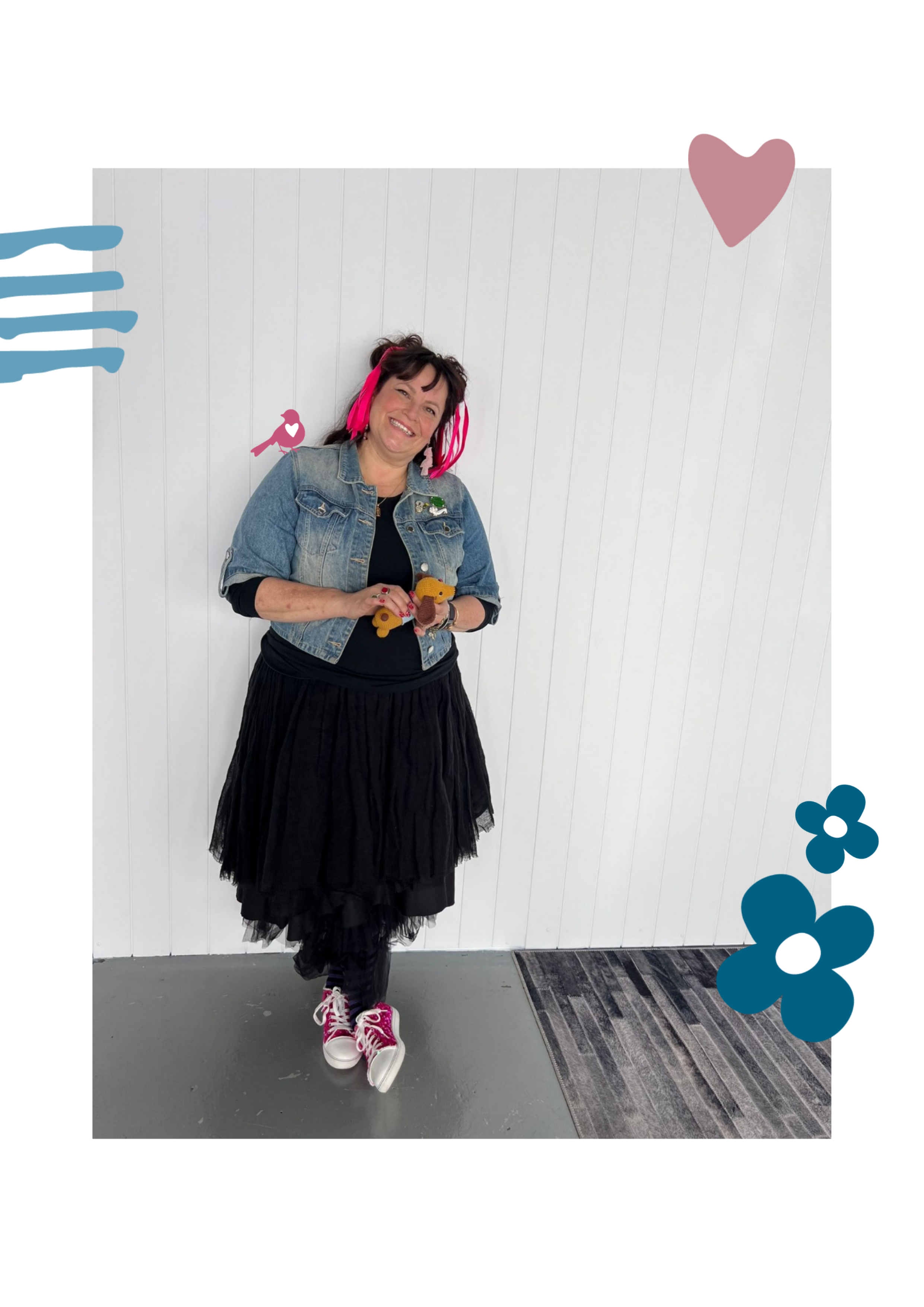
28 touchpoints. I nearly spat out my coffee.

Hiya,
I was at The Digital Picnic's Comeback Conference last week.
Two full days and a lot of very smart people. I wrote an embarrassing amount of notes but it was all gold.
And one statistic I haven't stopped thinking about.
28 touchpoints.
That's how many times someone needs to encounter your brand before they make a purchase decision and this is up from somewhere between 7 and 15 not that long ago.
Which means your website, your emails, your social, your ads, all of it has to be working together, saying the same thing, building the same trust, over and over and over.
If that number made something in your chest tighten, I understand completely.
Because for a solo founder running a business while managing an ADHD brain, possibly in perimenopause/menopause, and probably managing a household, a family and the majority of the mental load, 28 touchpoints is not a strategy.
It's an ambush.

For a long time, the marketing world has talked about funnels.
TOFU, MOFU, BOFU. Top of funnel, middle of funnel, bottom of funnel. If you know those terms, that’s brilliant, and if you don't, no shame, genuinely – I only knew Tofu as something that I would prefer not to eat. It's just a way of describing where someone is in the process of deciding whether to buy from you.
Top: they've just found you. They don't know you yet.
Middle: they're curious. They're watching.
Bottom: they're close. They just need something to tip them over.
The funnel pattern has been a backbone of marketing for a long time and it still exists and is used today. But now it sits as one piece inside a much bigger picture.
The idea was simple. People enter at the top and, in theory, move through the stages until they become clients. Awesome, wow…. Wouldn’t that be great.
But here's what the conference kept coming back to, and what I think is actually true.
It's not just a funnel anymore.
It's an ecosystem.
Every touchpoint.
A caption, an email, a reel, a referral from someone who trusts you and none of them exist in isolation. They work together, build on each other, and create something bigger than any single piece.
That word, ecosystem, kept coming up across two days and multiple speakers.
And honestly, it made me think of a village.
Not a machine. Not a pipeline. A village.
Lots of small things, each doing their part, creating something you would actually want to live in. Creating something bigger together.

That reframe matters because a funnel puts pressure on every single piece to perform.
An ecosystem allows for the reality that some things will be quieter than others on any given week and the whole thing still holds.
For a brain like ours, that's not just a nicer metaphor.
It's a more honest model for how we can actually show up.
Here's the thing that kept coming up, though.
Speaker after speaker, different backgrounds, different topics, different parts of marketing, kept giving us the same overall message.
Use AI for the parts that drain your capacity, so you can actually show up for the parts that matter, the parts you love and are genius at.
One of the speakers, Elizabeth, talked about using AI almost like a co-founder. Not in the sense of replacing your thinking, but as a form of decision relief for founder-led teams and individuals.
I loved this concept, especially for myself and my clients.
Because it is not just the admin AI can help with. It can hold logic, context, and information across a lot of moving parts. It can help think through options, organise decisions, and execute on the structure once you have made them.
And for an ADHD brain, that kind of support is not trivial.
When your brain is holding ten open tabs, five unfinished thoughts, and three decisions you meant to come back to yesterday, having somewhere external that can hold context and help structure the thinking can make an enormous difference.
Running a business can be incredibly lonely. Most of the decisions sit with you. The strategy, the priorities, the trade-offs, the constant recalibration.
Used well, AI can hold some of that weight.
Not by replacing judgement or lived experience, but by helping carry the thinking that surrounds it.

Another speaker talked about something founders are quietly expected to do now and that’s to be full-time content creators as well as running the business itself.
Her focus was on watching your data properly and understanding what is actually working in your marketing rather than guessing. Using AI to help analyse patterns, support strategy for socials, and create content that is guided by real signals rather than noise.
Better thinking. Clearer signals. Less guesswork.
Because here is the reality.
Attention is a decision.
Just like you choosing to read this newsletter right now.
All of us only have so much time. So much focus. So much bandwidth.
Which means our role as founders is to respect that. To show up with something that is actually worth someone's attention.
The 28 touchpoints aren't going away.
The marketing pressure isn't going away. The world in which we live and work is constantly evolving.
But the version where you white-knuckle your way through all of it, manually, on a neurotypical timeline, with a brain that's already carrying more than most people can see?
That version was never going to be sustainable, and I’m here to tell you that you don’t have to.
We don't need to do more. We need to be more deliberate about what we protect our energy and bandwidth for.
And this is where tools like AI can genuinely help. Used thoughtfully, with good scaffolding, safety checks, and a commitment to learning how to use it properly, it can take some of the load so your attention stays on the work that actually needs you.
And yes, I'm going to be honest about what happened after two days of peopling with hundreds of humans.
I came home and went horizontal.
Two full days. Bed. Netflix. Water bottle. Louie. That's it.

No spoons left. None. The cup was not just empty. It had been washed, dried, and put away.
And I want to say this clearly, because I know some of you will read about a two-day conference and feel that familiar thing. The mix of wanting it and already knowing the cost.
That cost is real.
For our brains, being in a room full of energy and information and connection for two days straight is not the same experience it is for everyone else.
It is genuinely, biologically more expensive.
The recovery isn't laziness and it isn't weakness, it's your nervous system doing exactly what it needs to do.
I needed those two days horizontal before I could process a single thing I'd learned.
And then, when I was ready, things started to land.
It will probably take a few more days for everything to fully settle, and that's okay. That is part of how my neurodivergent brain works. We tend to move in bursts and then rest so the system can recalibrate.
The notes started to make sense. The ideas connected. The thing I wanted to share with you slowly formed into something coherent.
That didn't happen in spite of the rest. It happened because of it.
So if you've been giving yourself a hard time about needing more recovery time than everyone else seems to need, this is me telling you that most people just aren't talking about it.
The village doesn't judge the rest days.
It actually depends on them.
Mel x
P.S. If the 28 touchpoints thing hit you and you're wondering where to even start, reply and tell me where the biggest drain is right now. I read every reply.
I don't just speak from experience. I do the reading too.
This article is worth reading if you are interested in knowing more. Mel x
1.Executive function deficits, ADHD, and job burnout Prem, R., et al. (2024).Executive function deficits mediate the relationship between employees' ADHD and job burnout.PLOS ONE.https://pmc.ncbi.nlm.nih.gov/articles/PMC11007411/
ADHD Village- PO Box 475, Clifton Hill, 3068, Australia