BOOM and DOOM, both good and bad
Hiya,
I use Claude every single day.
I want to be upfront about that. Not because I think you should. Not because AI is the answer to everything. But because I am a solo founder with an AuDHD brain and a business to run, and without it, the administrative tax on my nervous system would be enormous.
I use it to plan my day when my brain won't start easily.
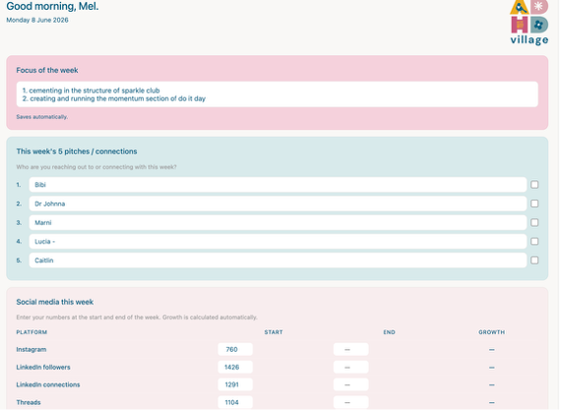
Every Monday morning, I open what I call my Monday Morning Dashboard. It lays out my calendar for the week, the urgent things, and what I actually want to prioritise. Not what I should prioritise. What I want to. Because if I cannot see it, it does not exist. That is not a metaphor. That is object permanence. ADHD brains genuinely struggle to hold things in mind that are not visible. Out of sight is not just out of mind. It is gone.
I am in full menopause. My working memory is not what it was.So I also use it to track my Village connections -- the women I have spoken to, the conversations I have had, where things are at -- before they make it into my CRM. I have a lot of chats. I cannot always remember who is who. Claude holds that for me. It remembers the details I have already lost.
For a brain like mine, in a body doing what mine is doing, that is not a productivity hack. That is a lifeline.
And I have been teaching my clients to use it too. Not in a complicated way. We are talking beginner level. How to plan your day without it becoming a two-hour colour-coded spiral.How to offload the tasks that eat your spoons so there are some left for the work that actually needs your brain.
Because here is something I feel strongly about. As we bring AI into our businesses, we cannot afford to hand it our thinking. The strategic stuff. The big decisions. The work that is uniquely ours. That has to stay with us. There is real science behind what happens to our neural pathways when we stop using them. And for women who have already watched perimenopause and menopause quietly rearrange their cognition, protecting our critical thinking is not optional. It is the whole point.
So what I teach is the opposite of outsourcing your brain. It is using AI to clear enough space that your brain can actually do its best work.
And here is where it gets complicated for me.
Right now, Australia is the second-largest destination for data centre investment in the world. The federal government wants us to be the Asia-Pacific AI hub. And the numbers behind that -- the electricity, the water, the land -- sit heavy with me.
In a country that has droughts. That has watched parts of itself burn. That is already having hard conversations about what we are leaving behind for the next generation.
I am not going to pretend I have resolved this for myself. I have not. I use the tool that holds my executive function together every single day, while also sitting with real worry about what it is costing the planet. Both of those things are true at the same time.
Professor Toby Walsh, chief scientist at UNSW’s AI Institute summed it up perfectly at the National Press club in February 2026
“In hindsight, the title should not be boom or doom, but boom AND doom. Because my childhood dreams are turning into a reality that is both good and bad."
My word of the year this year is retract. Not growth. Not more. Retract.
I chose it because I watched what the last couple of years did to the neurodivergent community. To all of us who feel too much, who care too much, who cannot look away from what is happening in the world. There is a lot happening. And our nervous systems were not built for the volume of it.
Justice sensitivity -- that thing where we feel the wrongness of things in our body, not just our head -- is not a flaw. It is information. The grief about the planet is real. The relief of having something that holds my executive function together is also real. And sitting in the middle of both of those things, without needing to fix the contradiction, is the work right now.
Retract does not mean give up. It means look after what is close to you. Your family. Your community. Your own nervous system. Because you cannot push out to help others from empty.
I don't have a tidy answer. I don't think there is one. But I think naming it honestly is better than pretending the joy and the worry don't live in the same house.
Sitting in the middle of both of those things, without needing to fix the contradiction, is not cognitive dissonance. That is moral complexity. And your brain is doing exactly what it should.
Sparkle Club opens in July 2026. It is the group program I have been building for women exactly like you. Part of what we work on together is AI -- not the tech version, the practical version. Which tasks to hand off. How to set it up for your specific brain. How to get an hour back without a six-week learning curve.If you want to be the first to know when doors open, hit reply and tell me you're interested.
And if any of this is bringing something up for you, or you've been wondering whether there's support out there for a brain like yours -- I'd love to hear from you. I genuinely love hearing from women founders who want to grow their businesses.
Mel x
P.S. Anthropic released data earlier this year showing Australians use Claude at four times the rate their population size would predict. We are early adopters. We are also the ones who will live with what gets built here. Both things. Same time.
Follow me and come say hiya:


ADHD Village- PO Box 475, Clifton Hill, 3068, Australia