Stop telling ADHDers “Everyone feels that way"
Hiya,
Let's talk about imposter syndrome.

You know the feeling. You've built something real. You have clients. You have results. You know your stuff.
But there's this voice that whispers: "You're winging it. Eventually someone's going to figure outyou don't know what you're doing."
Here's the thing traditional business coaches love to say: "Everyone feels like an imposter sometimes! It's totally normal for high achievers!"
And sure. That's true.
But for ADHD brains?Imposter syndrome hits completely differently.
Because you're not just battling the usual "am I good enough?" anxiety.
You're battling actual evidence your brain has been collecting for decades.
Here's why ADHD imposter syndrome is its own beast:
1. You have a lifetime of "proof" that you're faking it
Neurotypical imposter syndrome:"I feel like I don't belong here."
ADHD imposter syndrome:"I have 30 years of evidence that I'm barely holding it together."
You forgot the client call. You missed the deadline. You showed up late. You lost the document. You said you'd follow up and then… didn't.
Your brain isn't making this up.It happened. Multiple times.
So when you feel like an imposter, you've got receipts.
Your ADHD brain is an evidence-gathering machine, and it's been building a case against you since primary school.
2. You're compensating in ways nobody sees
High achievers without ADHD work hard.
High achievers WITH ADHD work hard AND spend invisible energy just to appear functional.
You set 17 alarms. You use body doubling to force yourself to start. You have backup systems for your backup systems because you don't trust your brain to remember.
So when someone says "you make it look easy," you want to laugh.
Becausethey're seeing the output.Not the Herculean effortit took to produce it.
And that gap between what people see and what it actually costs you? That feeds the imposter feeling.
Because you know how much you're compensating just to look "normal."
3. Your inconsistency makes you doubt your competence
You can be brilliant one day and barely functional the next.
You can nail a complex project and then forget to send a simple email for three weeks.
Neurotypical brains have relatively consistent executive function. So their competence feels stable.
ADHD brains? Our capacity fluctuates with dopamine, sleep, stress, hormones, and approximately 47 other variables.
So you start questioning:"Am I actually good at this? Or did I just get lucky on a high-dopamine day?"
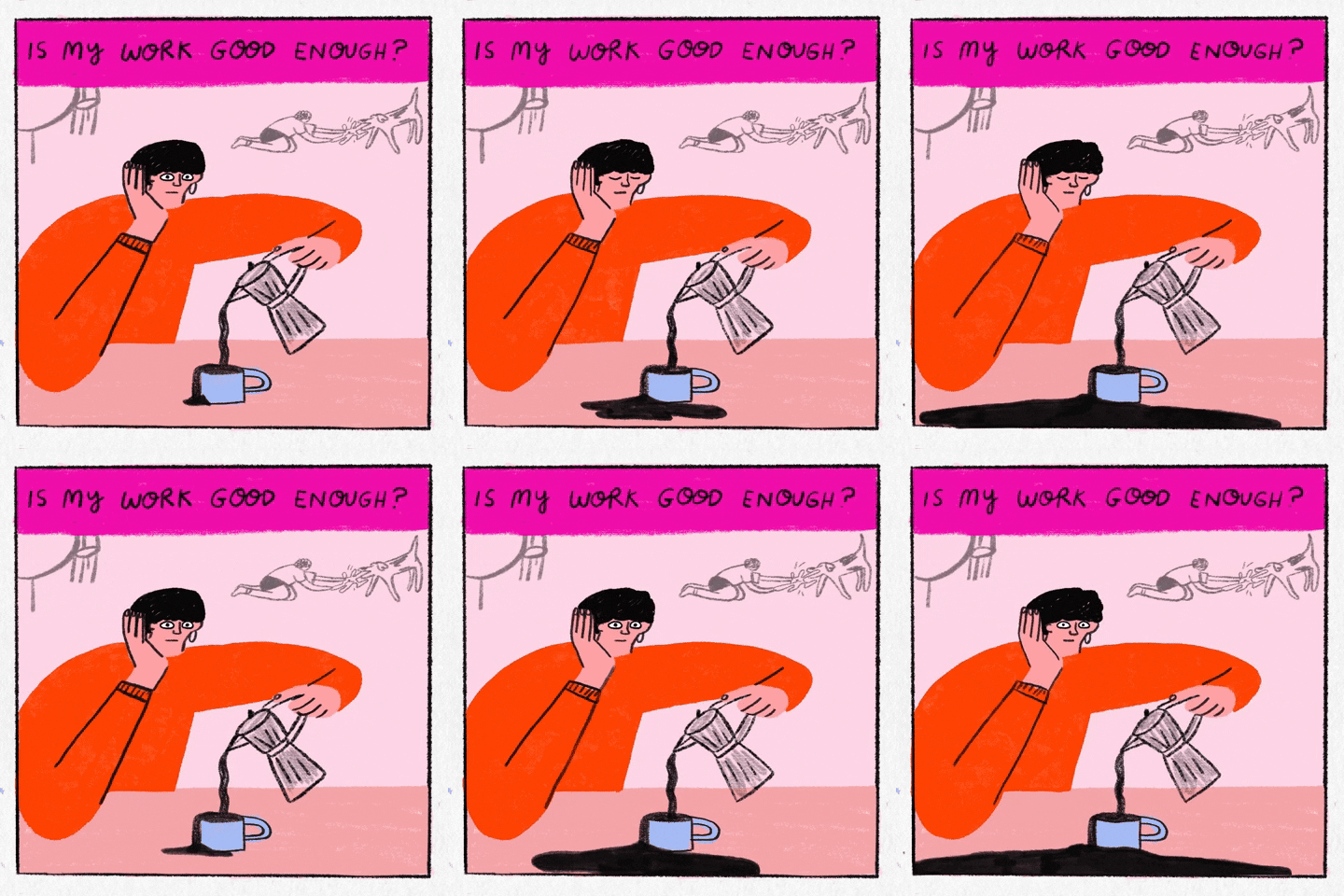
The inconsistency makes it hard to trust your own abilities.
Because you genuinely don't know which version of your brain is going to show up tomorrow.
4. You've been masking for so long, you don't know what's real anymore
You've spent years figuring out how to look like you have your shit together.
Smiling through the chaos.
Pretending you weren't completely overwhelmed.
Laughing off the forgot-again-didn't-you moments where on the inside you are dying ofshameandembarrassment.
So when you finally build something successful, there's this nagging question:"Is this the real me? Or am I just really good at performing 'successful business owner'?"
The line between masking and authentic competence gets blurry.
And that makes imposter syndrome worse.
Because you're not just questioning your skills. You're questioning whether the whole thing is an elaborate performance.
5. The shame compounds everything
Most people with imposter syndrome think: "I'm not sure I'm good enough."
People with ADHD imposter syndrome think: "I'm not sure I'm good enough, my brain doesn't work properly, and everyone's about to find out I've been faking basic competence."
It's imposter syndrome with an extra layer of "and also, something's fundamentally wrong with me."
We've internalized decades of messages - some subtle, some not - that our brains are the problem. That if we just tried harder, organised better, focused more, we'd be fine.
So the imposter feeling isn't just about skills or knowledge.
It's tangled up with shame about needing accommodations.
About the gap between effort and output.
About being "too much"and"not enough"simultaneously.
That's a different weight entirely.
Here's what I need you to hear, {{contact.first_name}}:

The imposter feeling isn't evidence that you're a fraud.
It's evidence that you've been measuring yourself against standards designed for brains that work differently than yours.
You're not faking competence-you're demonstrating incredible adaptability by succeedingin systems that weren't built for you.
The inconsistency?Neurology, not character flaw.
The compensating?Strategic genius, not deception.
The masking? Survival skill you developed because the world didn't accommodate you first.
You've built a real business while navigating obstacles most people don't even see.
That's not imposter syndrome. That's actual expertise earned the hard way.
This is why with my coaching clients, I use the Bandwidth, Brains & Business™ framework. We address the Brains piece - the biology AND the belief systems - because you can't build sustainable business success on top of shame and self-doubt.
Woman-owned. ADHD-powered. Unapologetically accommodated.
What part of ADHD imposter syndrome hits hardest for you? Hit reply and tell me - I read every response.
Mel x
P.S. If you're tired of feeling like a fraud in your own business, Sparkle Club starts with Bandwidth (nervous system regulation) and then moves into Brains - where we tackle both the biology of ADHD AND the belief systems (like imposter syndrome) that keep you stuck.
Because business tactics won't help if you don't believe you deserve the success.
RESOURCES ON ADHD, SELF-ESTEEM, AND IMPOSTER SYNDROME (For Adult Women)
Everything I write, I research.
I'm not just making this up, it’s not AI slop.
Here's what the science says about ADHD, self-esteem, and imposter syndrome - especially for adult women:
Attoe, D.E., & Climie, E.A. (2023). Miss. Diagnosis: A Systematic Review of ADHD in Adult Women.Journal of Attention Disorders, 27(7), 645-657. This systematic review found that women with undiagnosed ADHD often spend their lives feeling "different," "stupid," or "lazy" and blaming themselves for underachievement - and that receiving a diagnosis can be instrumental for women's self-esteem and identity. [https://journals.sagepub.com/doi/10.1177/10870547231161533]
Babinski, D.E., & Libsack, E.J. (2025). Adult Diagnosis of ADHD in Women: A Mixed Methods Investigation.Journal of Attention Disorders. Research showing women with ADHD experience increased self-doubt and low self-esteem, particularly due to increased self-awareness of their ADHD symptoms and concerns about negative evaluation by others. The study also found many women initially unaware their experiences were indicative of ADHD. [https://journals.sagepub.com/doi/10.1177/10870547241297897]
Wicherkiewicz, F., & Gambin, M. (2024). Relations Between Social Camouflaging, Life Satisfaction, and Depression Among Polish Women with ADHD.Journal of Autism and Developmental Disorders. This study found that efforts to mask ADHD symptoms and meet societal expectations are linked to lower life satisfaction and increased depressive symptoms in women with ADHD. [https://pubmed.ncbi.nlm.nih.gov/38809476/]
van der Putten, W.J., et al. (2024). Is camouflaging unique for autism? A comparison of camouflaging between adults with autism and ADHD.Autism Research, 17(4), 812-823. Research demonstrating that adults with ADHD engage in camouflaging behaviors (masking their symptoms), though the specific consequences for late diagnoses and mental health in ADHD populations require further study. [https://pubmed.ncbi.nlm.nih.gov/38323512/]