The time tax. It's not what you think.
Hiya,
My ADHD husband said he'd be ten minutes–a quick thing he had to do.
That was an hour ago.
I am a woman who has been watching this exact thing happen for thirty something years. And it still gets me every time. Because in his head, ten minutes is ten minutes.In reality, ten minutes is whatever unit of time stands between him and the thing that currently has his attention.TikTok has entered the chat.
Welcome to the time tax.
If the money tax is the dollars quietly leaving your account, the time tax is the hours quietly leaving your day. And just like the money tax, it's not carelessness. It's not disorganisation. It's a brain that experiences time differently to everyone around it.
I'll be honest. My autism saves me a little here. I am not as bad as my husband or my son. But I have my own version. And it costs me more than I'd like to admit.

Let's start with underestimating.
Six weeks ago, I decided to build a new website. From scratch. I gave myself two days.
We are six weeks in. And we are going to be a while.
Two days made complete sense at the time. It always does. The estimate feels completely reasonable in the moment. Two days. Totally doable. And then reality arrives and the two days stretches into two weeks and then six and somehow that still feels surprising. And a little annoying. Because the fun part is long done and what's left is the grunt work. The unsexy, necessary, please-can-someone-else-do-this part that my brain has absolutely no interest in.
It's not just big projects. It's everything.
Write a newsletter? Ten minutes.
Research a new topic. One hour.
And then there are the rabbit holes.
I sat down recently to research hormones and ADHD. Genuinely important topic. Genuinely good intentions. Somewhere along the way I saw a meme. It was related. Sort of. And then there was another one. Also related. Loosely. A couple of hours later I looked up and realised I had been ADHD meme scrolling for most of the afternoon.
The research was supposed to take an hour. The memes had other plans.
And here's the thing many people don't realise. Social media is engineered to be addictive. Every scroll, every meme, every autoplay is designed by very smart people to keep you there as long as possible.For a brain like ours, that is not a fair fight. We have addictive personalities by nature.They built the trap knowing exactly who would fall into it.
This is the rabbit hole tax. You start somewhere real and end up somewhere completely different, having lost hours you didn't have to lose and retained approximately nothing useful.
Then there's finding things.
Keys. And passwords. Always passwords.
I have LastPass. My son has the master password. Because if I try to remember it myself there is a very real chance, I wipe out our entire password collection in one optimistic attempt. This is not a hypothetical risk. This is a risk management decision I have made about myself, consciously, as an adult.
The document you saved somewhere very logical at the time. The thing you put in a safe place specifically so you wouldn't lose it, which is now the most lost it has ever been.
Long before we moved states, I put my daughter's Christmas present somewhere very safe. Tiny diamond earrings. Bought with so much love and the very specific thought of I'll put these somewhere safe, so they don't get lost. We later packed up every single belonging in that house. Every drawer, every cupboard, every corner.
To this day, I have never found them.
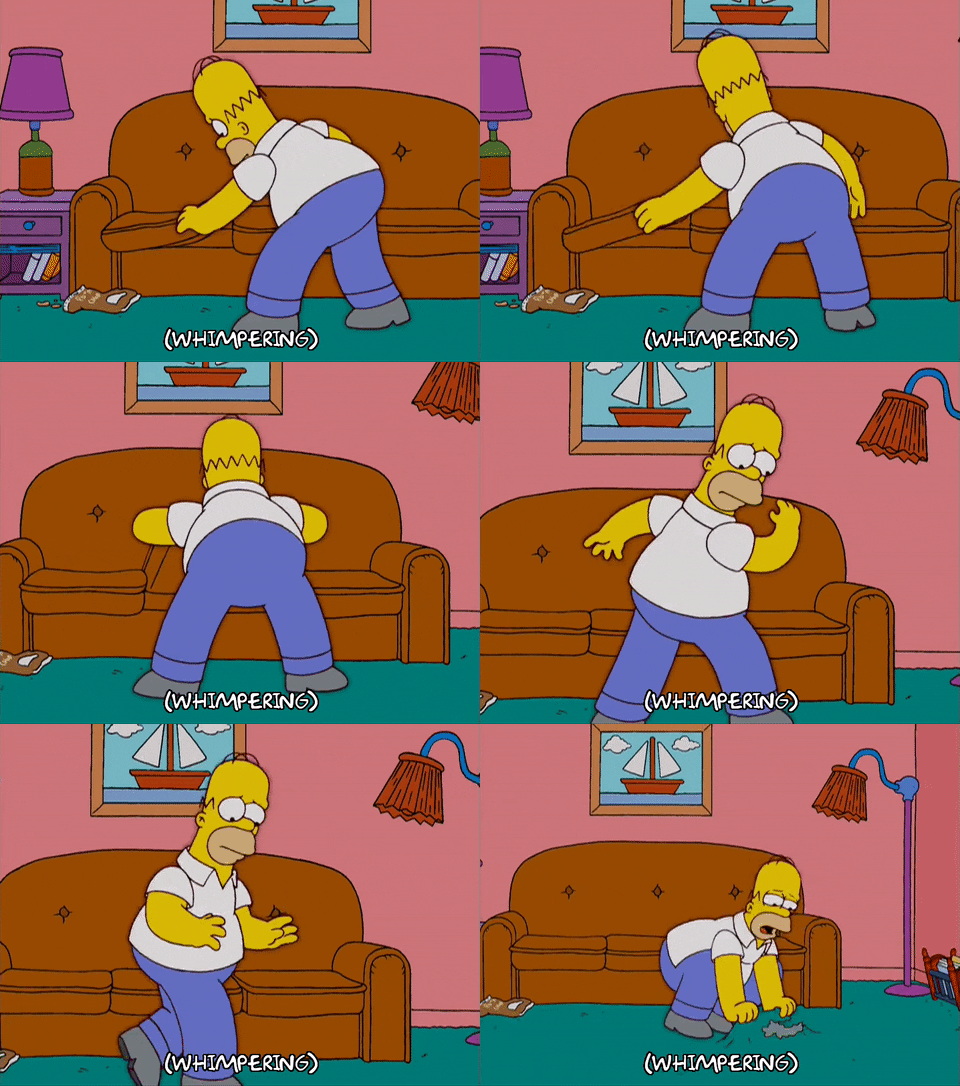
I stomp up and down our corridor when I can't find things. Like a toddler who has had their favourite toy confiscated. I am a grown, intelligent woman and I am stomping. Because the keys are somewhere. They have to be somewhere. And the stomping is apparently helping.
It is not helping.
The time spent looking for things is real time. Gone. Added to the pile of hours the time tax quietly collects every single day.
And finally. The panic window.
You've been avoiding something for weeks. And then the deadline arrives and suddenly, miraculously, you can do it. Fast. Focused. Done.
Except it doesn't feel miraculous. Because you didn't get to do the bit you actually love. The microscoping. The refining. The going back over it until it's exactly what you wanted it to be. The work is good. It's always good. But that knowing sits with you in a way nobody else would understand.
The panic window gets the thing done. It just doesn't get it done the way you wanted to.
So, what actually helps.

Hack one: the visual timer. I use an old-fashioned hourglass — sand, not digital. And a bright orange manual timer that shows me the countdown visually as the time disappears. I gamify it. Race the clock. Try to finish before the sand runs out. It works about fifty percent of the time. The other fifty percentI have to accept that today is not a deep workday and that is okay.
Hack two: get a Ken. Ken is my gorgeous VA who knows where all my digital things are. Passwords, files, the thing I saved somewhere logical three months ago. I ask her constantly. Having someone who holds the map of your digital world is not a luxury. For a brain like ours, it is infrastructure.
Hack three: when you're estimating time, break the project down into every individual task. Allocate time to each one. Add the whole thing up. And then add twenty percent minimum to that total. You will thank me later.We are constitutionally incapable of accurate time estimation without this. The two-day website would still have been optimistic. But it might have been closer.
Because here's what our brains actually need to hear.
We are not built for the long daily grind. We are interest based. We work in fits and starts, in bursts of focus and windows of flow. The neurotypical model of steady, consistent, daily progress was never designed for us. And measuring ourselves against it is its own kind of tax.
The time tax is real. It shows up in the underestimating, the rabbit holes, the very safe diamond earrings, and the panic window aftermath. It is not a discipline problem.
It is a brain difference.
And once you can see where it's costing you, you can start building workarounds that actually fit the brain you have.
Next week we’re talking about the convenience tax. And we've all paid it.
Mel x
ADHD Village- PO Box 475, Clifton Hill, 3068, Australia