We’re all a little ADHD, right?
Hiya,
“Oh I totally have ADHD too — I lose my keys all the time.”
“We’re all on the spectrum somewhere, right?”
Said casually.
Said like it’s relatable.
Said like it’s progressive.
And something in you tightens.
Your jaw.
Your chest.
Your stomach.
Because what you hear isn’t connection.
You hear your struggle— named or unnamed — brushed aside.
You hear your sensory overwhelm,
your masking,
your burnout turned into a meme.
You hear decades of trying harder reduced to “we’re all a bit like that.”

And for a split second, you wonder if you’re being too sensitive.
You’re not.
And in mid-life?
It becomes even more complex.
Because now it’s not just neurology.
It’s neurology under hormonal pressure.
So before we talk about the numbers, we need to talk about perimenopause.
1. The perimenopause link nobody warned us about
More than 90% of women with ADHD report a significant worsening of symptoms during perimenopause and menopause.
Not a little worse.
Not “a bit hormonal.”
Significantly worse.
Executive function dips.
Emotional regulation thins.
Focus becomes unpredictable.
Motivation fluctuates.
Sleep shifts.
Bandwidth contracts.
And this isn’t just late 40s.
For many women, symptoms intensify in their late 30s,
continue through their 40s,
and shift again into their 50s.
This is a decade-long neurological recalibration layered on top of ADHD.
Let’s be clear.
When oestrogen fluctuates, dopamine regulation shifts.
ADHD is fundamentally a dopamine regulation condition.
You do not need to be a neuroscientist to see the interaction.
If this were a male-dominant condition —
if 90% of men experienced this in mid-life —
there would be national symposiums.
Pharmaceutical taskforces.
Government funding rounds.
Prime-time panels.
There would be urgent language.
Instead, women are told:
“It’s just stress.”
“It’s just hormones.”
“You just have to deal with it.”
So we sit in office buildings where the temperature is calibrated to the metabolic comfort of men, managing hot flushes in blazers.
We sleep badly for years.
We maintain the same workload, often more.
We run businesses, teams, households.
And we are expected to perform as if nothing biological is happening.
This isn’t man-bashing. It’s systems analysis.
Most workplace standards, medical trials, and productivity expectations were designed around male physiology as the default.
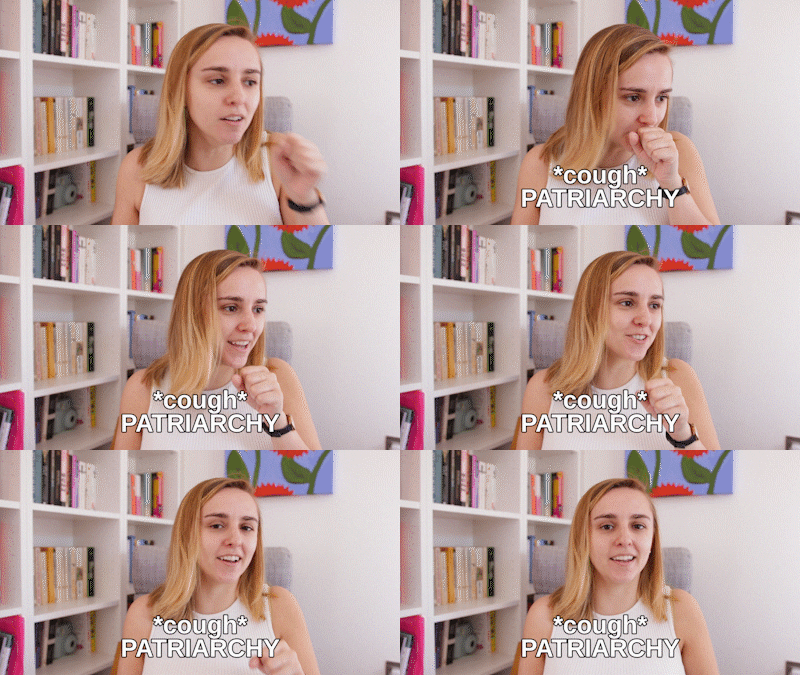
And yes, as a late-stage feminist, sometimes the lack of women-centric neurological and hormonal research makes me want to scream.
Because this isn’t niche.
This is millions of mid-life women trying to function in high-demand roles with a brain that is recalibrating under hormonal pressure.
Have you been increasing pressure at the exact time your biology required adaptation?
Have you interpreted physiological change as personal decline?
If your symptoms intensified in your late 30s, 40s, or into your 50s and you thought,
“I used to cope better than this,”
you’re not imagining it.
Your operating system is responding to hormonal change.
That calls for structural adjustment.
Not self-judgement.
2. Women have been catastrophically underdiagnosed — and it wasn’t random
In childhood, boys are diagnosed at roughly three times the rate of girls.
By adulthood, that ratio becomes almost 1:1.
Girls didn’t suddenly develop ADHD at 35.
We were missed.
I was misdiagnosed with depression and anxiety and medicated for 20 years.
Twenty years of believing I was too emotional.
Too inconsistent.
Too much.
Not enough.
When I was finally diagnosed with ADHD and autism, I wept.
Joy, because there was finally a map.
Grief, because of how long I’d been navigating without one.

We weren’t dramatic.
We were undiagnosed.
Research shows adult women with ADHD are significantly more likely to be misdiagnosed with anxiety or depression first, often spending years in treatment before the underlying condition is identified.
When someone says, “Everyone has a little ADHD,” it flattens decades.
3. The research on ADHD is real — and the numbers are significant
Around 6–7% of Australians live with ADHD.
Roughly 1 in 20 adults.
Around 800,000 people.
Diagnoses have more than doubled in the past decade.
The economic cost?
$12.83 billion per year in direct costs alone.
This is a measurable neurological condition with national impact.
Not a personality type.
Not a productivity quirk.
Not a punchline.
And yes, sometimes it feels like you’re surrounded by far more than 1 in 20.
Of course you are.
We pod.
4. What actually happens when people minimise it
Most people who say “everyone has a little ADHD” are trying to relate.
But impact matters more than intent.
It suggests the struggle isn’t serious.
It suggests accommodations aren’t necessary.
It suggests the years of self-doubt were an overreaction.
Minimising ADHD doesn’t just erase struggle.
It blocks strategy.
If it’s “just a quirk,” you don’t redesign your workload.
If “everyone has it,” you assume you should cope the same way.
And that’s where women burn out.
You have a different operating system.
Different operating systems require different infrastructure.
So what do you actually do with all of this?
Here are three shifts that matter.
1. Check your capacity first — then decide what actually gets done today
If you have 10 things on your list and the capacity to do 2,
you will feel bad at the end of the day.
Every time.
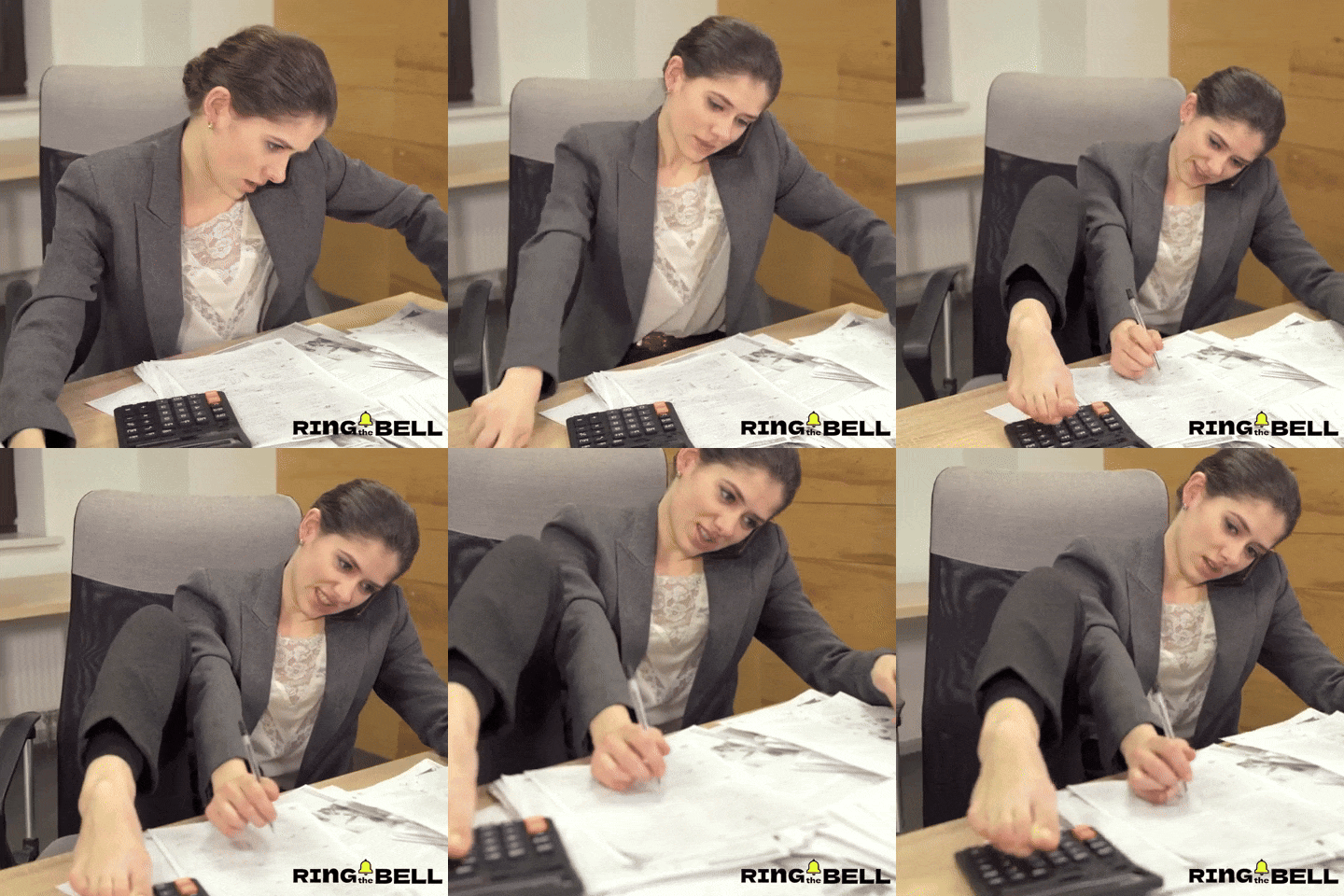
Not because you failed.
Because you planned for the wrong version of yourself.
Stop planning for high-capacity Tuesday {{contact.first_name}} when it’s clearly a Wednesday.
Do fewer things.
Give yourself more time to do them.
Stop making decisions when your brain is already fried.
Close some of those 47 browser tabs.
Ask daily: What is my actual bandwidth today?
Not what it “should” be.
What is it.
2. Track patterns, not moods
Instead of saying, “I’m a mess lately,” get curious.
Notice sleep.
Notice hormonal shifts.
Notice when focus disappears.
Data is more useful than shame.
3. Redesign your work to fit your brain — not the other way around
You probably have approximately 32 notebooks and 3 planners.
Pretty much all of them are beautiful.
And when you bought them, they were going to fix everything.
Most have two weeks of entries and then… nothing.
Stop running your life and business on memory and adrenaline.
And stop measuring yourself against people whose brains work differently.
You don’t believe you’re behind because of your to-do list.
You believe you’re behind because the goalpost keeps moving.
Not who you were at 32.
Not who you “should” be.
Now.
That’s how experienced women build businesses that last.
Mid-life isn’t the decline.
It’s the recalibration.
If you want support building around the version of you that exists now, not the one from 2010, let’s chat.
Woman-owned. ADHD-powered. Unapologetically accommodated.
Mel x
If you want to geek out on the science, I’ll always provide the links.
Because evidence matters.
Australian ADHD prevalence & statistics
Australian evidence-based clinical practice guideline for ADHD (PMC)https://pmc.ncbi.nlm.nih.gov/articles/PMC10363932/
Medical Journal of Australia (2025)https://www.mja.com.au/journal/2025/223/8/adult-attention-deficit-hyperactivity-disorder-australia-how-its-current
ADDing Up — PMC
https://pmc.ncbi.nlm.nih.gov/articles/PMC10809719/
Women & late diagnosis
Attoe, D.E., & Climie, E.A. (2023)
https://pmc.ncbi.nlm.nih.gov/articles/PMC10173330/
Perimenopause & ADHD symptoms
Perimenopausal Symptoms in Women with and without ADHD
https://pmc.ncbi.nlm.nih.gov/articles/PMC12538516/
Eunethydis Special Interest Group on Female ADHD (2025)